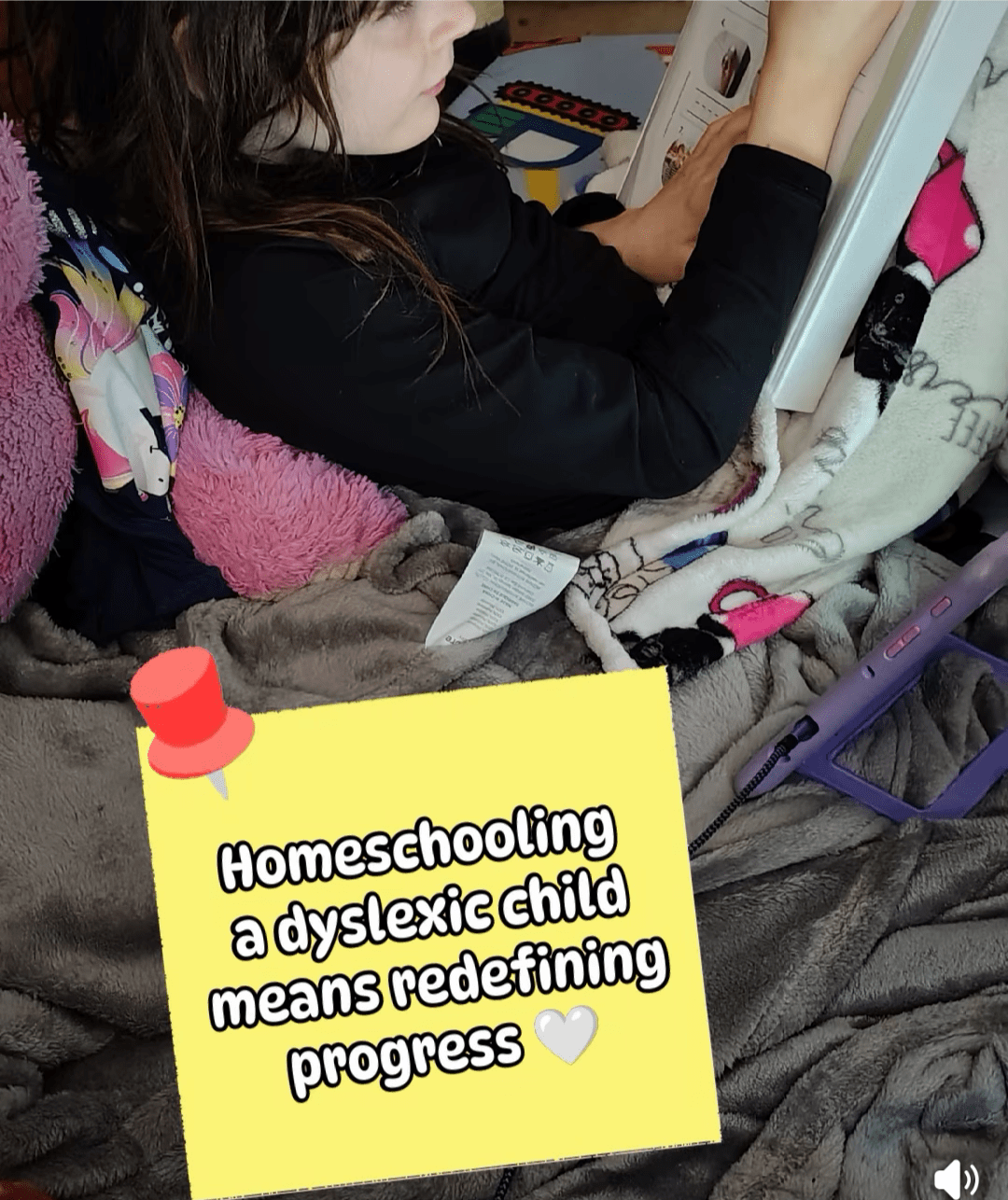
Homeschooling a dyslexic child has reshaped how I understand learning, growth, and progress.
For a long time, I measured progress by speed. How quickly lessons were completed. How smoothly things flowed. How much we checked off the list in a day.
But dyslexia gently and persistently disrupted that way of thinking.
Because progress, I’ve learned, doesn’t always look like speed.
Slow Does Not Mean Stuck
Some days are slow.
Some lessons take longer than planned.
Some concepts need to be revisited again and again.
At first, this felt discouraging. I worried we were falling behind or not doing enough. But over time, I began to see something different.
Slow doesn’t mean stuck.
It means the brain is working.
It means connections are being built in a different way.
Dyslexic learners often need more time, not because they are incapable, but because their brains process information differently. And different doesn’t mean deficient.
Quiet Victories Matter
Some victories don’t look impressive from the outside.
They look like:
- A word finally read without tears
- A paragraph attempted with confidence
- A child willing to try again instead of shutting down
- A moment when frustration is replaced with perseverance
These victories are quiet, but they are significant.
When learning happens differently, confidence becomes just as important as content.
Adjusting the Pace Is Not Lowering the Bar
One of the most important lessons I’ve learned is that adjusting the pace is not the same as lowering expectations.
We aren’t giving up. We aren’t settling for less. We aren’t assuming inability.
We are choosing a pace that allows understanding to take root.
Slowing down protects confidence, preserves curiosity, and keeps learning from becoming a source of shame or fear.
And in the long run, that matters more than rushing through material that doesn’t stick.
Guarding Confidence Is Part of Education
For dyslexic children especially, confidence can be fragile.
Repeated struggles with reading, spelling, or writing can quietly chip away at a child’s belief in themselves. That’s why how we teach matters just as much as what we teach.
Encouragement matters. Patience matters. Celebrating effort matters.
When a child believes they are capable, they become willing to try again. And that willingness opens the door to real learning.
Learning Differently Does Not Mean Learning Less
This might be the most important truth of all.
Learning differently does not mean learning less.
It means:
•Different strategies
•Different timelines
•Different measures of success
Dyslexic children are often creative, intuitive, big-picture thinkers. They bring strengths that don’t always show up on worksheets or standardized timelines, but they are strengths nonetheless.
When we honor those differences, we help our children see themselves as capable, not broken.
Trusting the Process One Day at a Time
Homeschooling a dyslexic child has also taught me patience as a parent.
Patience with the process.
Patience with my expectations.
Patience with myself on days when I feel unsure.
I’m learning to trust that God is not concerned with speed. He is concerned with growth, confidence, and the way our children see themselves.
“He has made everything beautiful in its time.” Ecclesiastes 3:11 ESV
Learning unfolds in time, just like everything else.
A Gentle Encouragement for Other Parents
If you’re homeschooling a dyslexic child and feeling discouraged, hear this:
You’re not failing.
Your child is not behind.
And slow progress is still progress.
Every day you show up, adjust, encourage, and protect your child’s confidence, you are doing meaningful work.
Learning doesn’t need to look fast to be faithful.
And your child is capable exactly as they are.
 Living Life with a Purpose