For years, I assumed that “free & clear” meant safe.
No scent. No dye. No problem… right?
But after walking through ingredient lists line by line, especially when our kids started reacting to products marketed as “gentle,” I realized something important:
Fragrance-free doesn’t automatically mean non-toxic or baby-safe.
Many detergents remove perfume but still rely on harsh surfactants, preservatives, enzyme systems, and processing agents that can linger on clothes and irritate sensitive skin.
So we took a step back.
We created a very specific standard for what we will and won’t use on our family’s laundry — especially for babies and kids.
🚫 Our Personal “No List”
We avoid detergents containing:
- Sulfates (SLS / SLES)
- Ethoxylates
- Petrochemical surfactants
- Chlorine
- Phosphates
- Formaldehyde donors
- Phenoxyethanol
- Optical brighteners
- Synthetic dyes or fragrance
- VOCs / SVOCs
- Endocrine disruptors
- MIT / MCI
- Titanium dioxide
This doesn’t mean every product outside our list is “toxic.”
It means they don’t align with our standards, especially for sensitive skin.
🌟 BEST OPTIONS
(Cleanest formulas, strong transparency, baby-appropriate)
These are the detergents we’re most comfortable recommending:
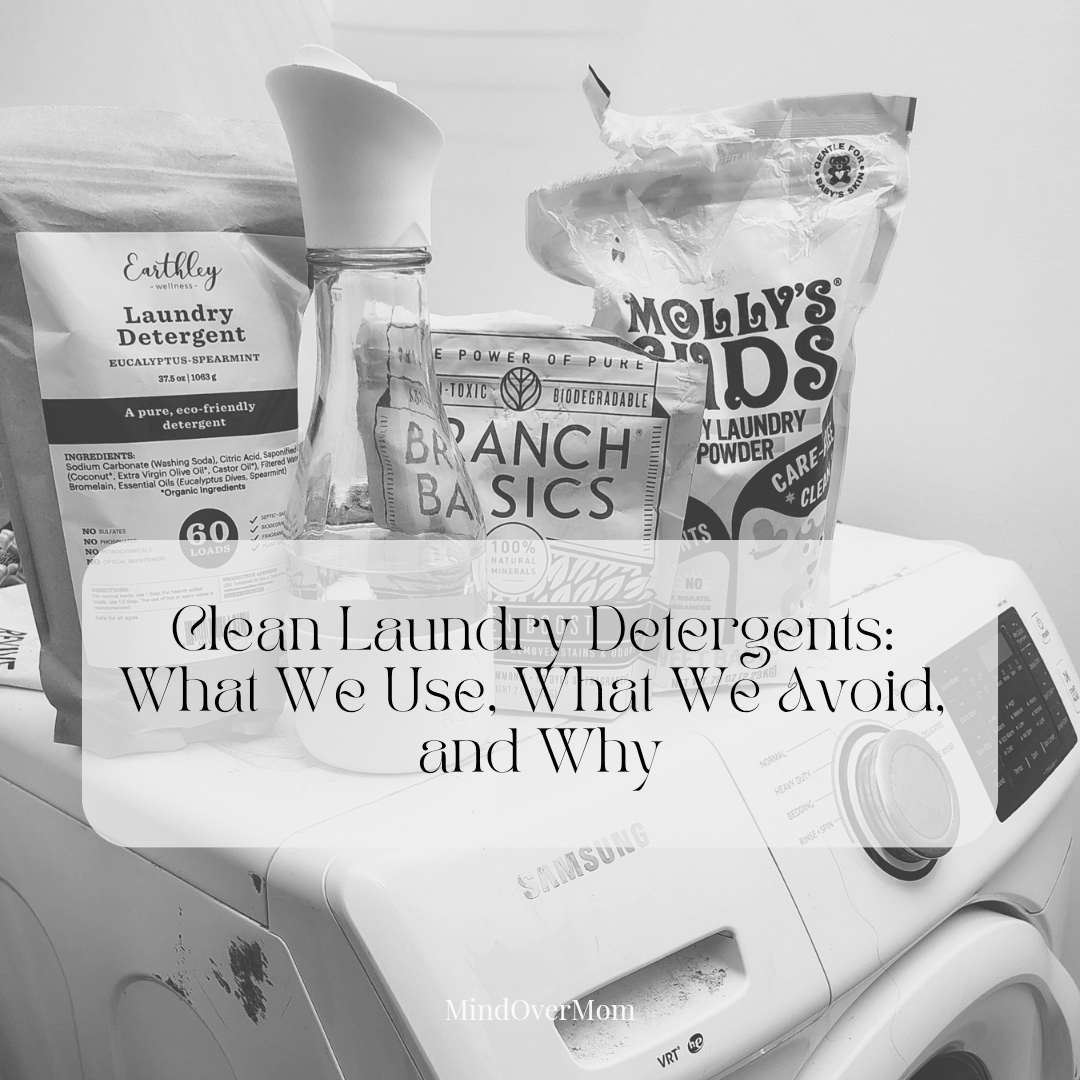
- Branch Basics Laundry Detergent Powder
- Branch Basics Concentrate + Oxygen Boost (used together)
- Root & Splendor Free & Clear
- Molly’s Suds Baby Laundry Powder
- Earthley Laundry Detergent (Unscented)
- Rowe Casa Laundry Detergent Powder (Unscented)
- Humble Suds Laundry Soap (Unscented)
Why these made the list:
✔ No fragrances or dyes
✔ No preservatives of concern
✔ No ethoxylates or petrochemicals
✔ Transparent ingredient lists
✔ Perform well when used correctly
🟡 OK OPTIONS
(Cleaner than conventional but with tradeoffs)
These may work for some families, but didn’t fully meet our criteria:
- Truly Free Laundry Wash (Unscented)
- Zuma Kids-Safe Laundry Detergent
- Rowe Casa Liquid Laundry Detergent (Unscented)
Why they landed here:
- Still clean overall
- But include gentler synthetic surfactants, essential oils, or limited cleaning power
- May work better as rotation options than primary detergents
❌ AVOID (For Our Standards)
This doesn’t mean “bad” — it means not aligned with sensitive-skin, non-toxic priorities:
- Tide Free & Gentle
- All Free Clear
- Seventh Generation Laundry Detergent
- Method Laundry Detergent
- Melaleuca MelaPower
- Norwex PowerZyme
- Norwex Ultra Power Plus
- Norwex Liquid Laundry Detergent
Most of these still rely on:
- Ethoxylated surfactants
- Petrochemical detergent systems
- Preservatives like phenoxyethanol
- Heavy enzyme loads
🚫 Common Laundry Ingredients Many Families Choose to Avoid (And Why)
Avoiding these doesn’t mean panic — it means choosing lower exposure where possible.
Sulfates (SLS / SLES)
Why people avoid them:
- Very strong cleansing agents
- Can strip natural oils from skin
- Common cause of irritation and dryness
Potential concerns:
- Skin barrier disruption
- Can worsen eczema or sensitive skin
- SLES can be contaminated with 1,4-dioxane during manufacturing
Why it matters in laundry:
Residue stays on clothes that touch skin all day.
Ethoxylates
(Often ends in -eth, -ethoxylated, Laureth, Alketh)
Why people avoid them:
- Created through ethoxylation (chemical processing)
- May be contaminated with 1,4-dioxane
Potential concerns:
- Classified as a contaminant of concern
- Not required to be listed on labels
- Long-term exposure concerns
Why it matters:
Even “plant-based” surfactants can be ethoxylated.
Petrochemical Surfactants
Why people avoid them:
- Derived from petroleum
- More aggressive than plant- or mineral-based alternatives
Potential concerns:
- Higher irritation potential
- Environmental persistence
- Not aligned with low-toxin goals
Why it matters:
Often found in “free & clear” detergents that still cause rashes.
Chlorine / Chlorine Bleach
Why people avoid it:
- Extremely harsh
- Can off-gas irritating fumes
Potential concerns:
- Skin and respiratory irritation
- Can react to form chlorinated byproducts
- Environmental toxicity
Why it matters:
Not necessary for effective laundry cleaning.
Phosphates
Why people avoid them:
- Primarily an environmental concern
Potential concerns:
- Contribute to water pollution and algae blooms
- Harm aquatic ecosystems
Why it matters:
Many countries restrict them — better alternatives exist.
Formaldehyde Donors
(Preservatives that slowly release formaldehyde)
Why people avoid them:
- Formaldehyde is a known carcinogen
- Used to extend shelf life in liquids
Potential concerns:
- Skin sensitization
- Allergic reactions
- Long-term exposure risks
Why it matters:
Laundry detergent residue = repeated skin exposure.
Phenoxyethanol
Why people avoid it:
- Common synthetic preservative
- Frequently causes irritation in sensitive individuals
Potential concerns:
- Linked to contact dermatitis
- Especially problematic for infants
- Listed as restricted in baby products in some countries
Why it matters:
Found in many “clean” liquid detergents.
Optical Brighteners
Why people avoid them:
- Do not clean — they coat fabrics to reflect light
- Make clothes look brighter without removing dirt
Potential concerns:
- Can cause skin irritation
- Build up on fabrics
- Toxic to aquatic life
Why it matters:
Residue stays on clothes and touches skin.
Synthetic Dyes or Fragrance
Why people avoid them:
- One of the top triggers for skin reactions
Potential concerns:
- Hidden fragrance blends
- Allergens and sensitizers
- Endocrine-disrupting potential
Why it matters:
“Fragrance” can contain dozens of undisclosed chemicals.
VOCs / SVOCs
(Volatile & Semi-Volatile Organic Compounds)
Why people avoid them:
- Evaporate into indoor air
Potential concerns:
- Headaches
- Respiratory irritation
- Indoor air pollution
Why it matters:
Laundry products impact air quality 24/7 inside the home.
Endocrine Disruptors
Why people avoid them:
- Interfere with hormone signaling
Potential concerns:
- Developmental effects
- Fertility issues
- Thyroid disruption
Why it matters:
Hormonal systems are especially vulnerable in babies and children.
MIT / MCI (Methylisothiazolinone / Methylchloroisothiazolinone)
Why people avoid them:
- Extremely common allergen
Potential concerns:
- Well-documented skin sensitization
- Frequently linked to eczema and rashes
Why it matters:
Even tiny amounts can trigger reactions.
Titanium Dioxide
Why people avoid it (in laundry specifically):
- Used as a whitener, not a cleaner
Potential concerns:
- Inhalation risk when powdered
- Environmental accumulation
- No benefit for skin safety
Why it matters:
Unnecessary additive for laundry performance.
🤍 Important Perspective
Avoiding these ingredients doesn’t mean everything containing them is “toxic.”
It means we choose lower-exposure options — especially for items that touch our skin daily.
Why These Popular Laundry Brands Are on Our “No List”
Before we get into specifics, it’s important to say this clearly:
Putting a brand on our No List does not mean it is “toxic” or that people using it are doing something wrong.
It simply means those products don’t align with our standards for ingredient transparency, low-toxin living, and sensitive skin—especially for babies and kids.
Many of these brands clean very well. Our decision came down to how they achieve that clean.
Below is a breakdown of why we personally choose to avoid each one.
Tide (Including Free & Gentle)
Why it’s popular:
Widely available, strong cleaning power, fragrance-free option.
Why it’s on our No List:
Even the “Free & Gentle” version relies on:
- Petrochemical surfactants
- Ethoxylated ingredients
- Synthetic polymers
- Heavy enzyme systems
While fragrance and dyes are removed, the core detergent chemistry remains industrial. Many families still experience skin irritation, residue buildup, or eczema flares.
All Free Clear
Why it’s popular:
Dermatologist-recommended, marketed for sensitive skin.
Why it’s on our No List:
Similar to Tide in formulation, All Free Clear commonly includes:
- Petrochemical surfactants
- Ethoxylates
- Synthetic processing agents
- Enzymes
Removing perfume doesn’t necessarily mean removing irritants. For sensitive households, this one still felt too harsh.
Seventh Generation Laundry Detergent
Why it’s popular:
Marketed as plant-based and eco-friendly.
Why it’s on our No List:
Depending on the product line, Seventh Generation detergents may contain:
- Ethoxylated surfactants
- Phenoxyethanol (in liquid versions)
- Synthetic preservatives
- Enzymes
- Essential oils (in scented formulas)
While it’s a step up from conventional brands, we found the formulations inconsistent and still problematic for very sensitive skin.
Method Laundry Detergent
Why it’s popular:
Stylish branding, “plant-based” messaging.
Why it’s on our No List:
Method detergents often include:
- Synthetic fragrance blends or essential oils
- Ethoxylated surfactants
- Preservatives like phenoxyethanol
- Synthetic dyes (in some versions)
“Plant-based” does not always mean low-toxin. For us, fragrance and preservative systems were the deal-breakers.
Melaleuca MelaPower
Why it’s popular:
Marketed as wellness-focused and cleaner than mainstream brands.
Why it’s on our No List:
This formula contains:
- Fluorescent (optical) brighteners
- Preservatives like methylisothiazolinone
- Harsh surfactants
- Limited ingredient transparency
In our experience, it caused skin reactions and did not align with our non-toxic standards despite “clean” marketing.
Norwex Laundry Detergents (All Versions)
Why it’s popular:
Strong cleaning performance, EWG-verified claims.
Why all Norwex laundry detergents are on our No List:
Across their formulas, we consistently saw:
- Ethoxylated surfactants
- Petrochemical detergent chemistry
- Heavy enzyme systems
- Preservatives like phenoxyethanol (liquids)
These products are performance-driven, not sensitivity-driven. For baby laundry and eczema-prone skin, they felt too aggressive. (although I love their dryer balls)
🤍 Final Thought
Laundry detergent lives on your clothes — and then on your skin.
For us, that means choosing simplicity, transparency, and consistency over marketing buzzwords.
Avoiding a product does not mean we think it’s unsafe for everyone.
It means we’ve chosen simpler, more transparent, lower-residue options for our family.
There is no perfect detergent. There are only better fits for different needs.
For us, laundry touches skin every single day—so we choose to be extra intentional here.
 Living Life with a Purpose